


Your Leading Hangzhou Qiandao Lake Alpine Foreign Trade Ltd. Supplier
Hangzhou Qiandao Lake Alpine Foreign Trade Ltd was established in . It is a leading supplier of yarn and fabric more than 10 years. It mainly engaged in producing virgin and recycled POY, DTY, ACY, FDY, Embroidery thread. Specification is based on 50D to 1200D and capacity is 9000 tons monthly. We have exported to many countries and regions, such as Turkey, Pakistan, Spain, Mexico, Brazil etc.
Why Choose Us?
High quality
We use the most advanced machinery and equipment and the best raw materials for production.
Competitive Price
Based on your order quantity, we can offer you a discount. The larger the order quantity, the greater the discount.
Rich experience
We have nearly 20 years of production experience, rich experience and high-quality management to ensure the quality of our products.
After-sale service
We provide comprehensive after-sales service to ensure that customers have a good practice of our products.
Related Product

Polyester Yarn For Knitting, used for hand-knitting fabrics or the production of knitwear. It has the features of smooth surface, low twisting and the soft feeling.

Polyester Fully Drawn Yarn, also called FDY. It is made by spinning in one step, normally using for weaving and warp knitting. 100% evenness and sustainable feature.

Full drawn yarn produced from the melting and extrusion of the polyester chips,at higher spinning speed coupled with intermediate drawing integrated in the process itself. Articles from 30D to 500D.

Polyester Filament Yarn use polyester chips as raw material. Various specifications, mainly from 50D to 900D. Thousands of colors for your choice.


Soft Polyester Yarn, made from polyester chips, spin with master batch, Covering denier 50D to 450D. Anti-Bacteria, Sustainable, High-Tenacity, Moisture-Absorbent.

White Polyester Yarn have 75D, 100D, 150D, 300D. Bleach white (optical white). Evenness, High-color fastness, High-elastic. OEKO-TEX Class I.

Polyester Fabric Yarn Merits
High quality
Environment protected
Excellent strength
Over 400 colors in stocks.
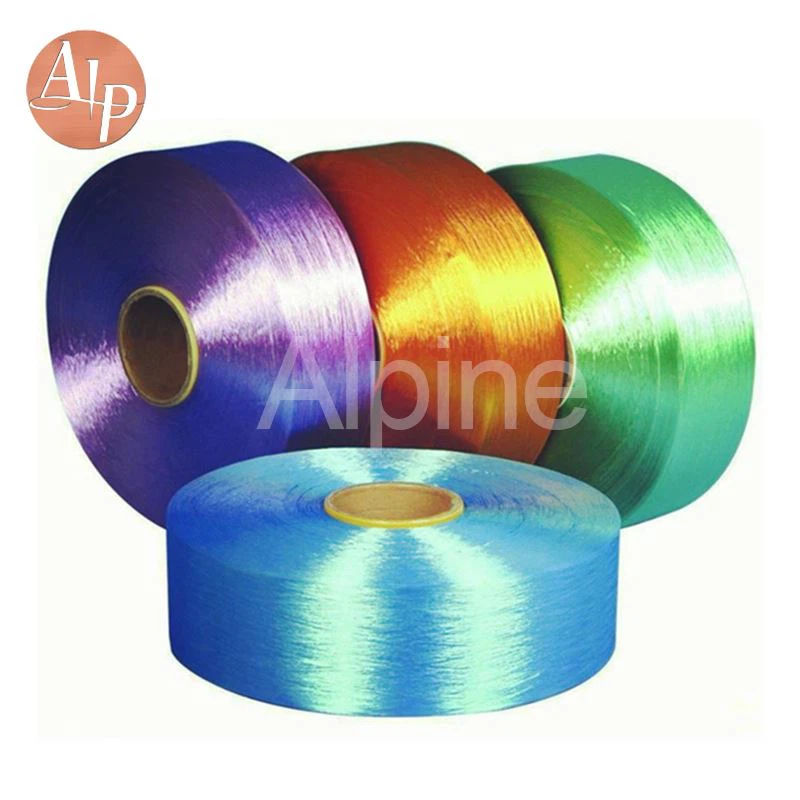
100% Polyester Poy Fdy, Filament Yarn, DDB Or Other Dope Dyed Colors. POY is used for making Polyester Drawn Textured Yarn (DTY). Both have gained the recognition of Oeko Tex Standard 100 (Class I). They are widely used in woven label , overlooking , ribbon, rope, shoelace, elastic tape etc.
What is Polyester Filament Yarn?
Polyester filament yarns is utilized as a part of sewing and weaving to make polyester fabrics, for example, customer fabrics and home outfitting like curtains, bed sheets, bed spreads and draperies. Thus Polyester high tenacity industrial yarns can be utilized to make ropes, conveyor belts, safety belts & tire fabric.
Benefits of Polyester Filament Yarn
Strength and durability
One of the key advantages of polyester filament yarn is its exceptional strength and durability. Polyester filament yarns are known for their high tensile strength, resistance to stretching, tearing, and abrasion, making them suitable for a wide range of textile applications. Whether used in apparel, home textiles, or technical textiles, polyester filament yarns offer excellent durability and longevity, ensuring that the finished products maintain their quality and performance over time.
Colorfastness
Polyester filament yarns can be dyed in a wide range of vibrant colors that remain colorfast even after repeated washing and exposure to sunlight. This colorfastness is a significant advantage in textile manufacturing, as it ensures that the colors of the finished products remain vibrant and true for an extended period. Whether used in apparel, upholstery, or outdoor fabrics, polyester filament yarns offer long-lasting color retention, enhancing the aesthetic appeal and value of the finished products.
Versatility in design
Polyester filament yarns offer versatility in design, allowing manufacturers to create a wide range of textures, finishes, and effects. These yarns can be textured, twisted, or blended with other fibers to achieve specific aesthetic and performance characteristics. Whether producing fashion apparel, home textiles, or technical textiles, manufacturers can leverage the versatility of polyester filament yarns to create innovative and unique products that meet the diverse needs and preferences of consumers.
Moisture wicking
Polyester filament yarns have inherent moisture-wicking properties, meaning they can absorb and transport moisture away from the skin to keep the wearer dry and comfortable. This moisture-wicking ability is particularly advantageous in activewear, sportswear, and outdoor apparel, where moisture management is essential for performance and comfort. Polyester filament yarns enable the production of breathable and moisture-wicking fabrics that enhance the wearer's comfort during physical activities.
Environmental sustainability
While polyester filament yarns offer numerous advantages in textile manufacturing, they also contribute to environmental sustainability. Polyester filament yarns can be recycled and repurposed into new products, reducing the environmental impact of textile waste. Additionally, advances in manufacturing technologies have enabled the production of polyester filament yarns using recycled materials and eco-friendly processes, further enhancing their sustainability credentials.
Types of Polyester Filament Yarn
POY yarn
Partially Oriented Yarn, or POY, is a basic form of polyester yarn. To make our recycled polyester POY, clean polyethylene terephthalate (PET) bottle chips are melted, extruded, and stretched at moderate speed. The resulting molecular structure is "partially oriented", giving the yarn lower strength than fully drawn yarn, but geater flexibility to be processed into other types of yarn. As such, most POY is used as an intermediate to make a different yarn type, such as DTY or ATY.
FDY yarn
FDY stands for "fully drawn yarn". The process to make FDY is very similar to that used to make POY, but the yarn is stretched ("drawn") at faster rates upon extrusion. The resulting PET molecular structure is more ordered and aligned, giving FDY higher strength. FDY is a smooth, straight yarn, and fabrics woven from this yarn feature a glossy sheen and low friction, "slippery" handfeel.
DTY yarn
DTY yarn, also known as Drawn Texturized yarn, is manufactured by drawing and texturing POY. As a result of this process, the filaments comprising the POY yarn are dispersed, entangled, and crimped. This gives DTY the matte appearance and fluffier hand feel akin to a natural fiber, while retaining the strength of a synthetic fiber.
ATY yarn
Air Textured Yarns (ATY) is a type of synthetic filament yarn that is also called cotton-like yarn for its natural fiber-mimicking handfeel. To make ATY, POY is textured with jets of air, introducing many small distinct loops. These give fabric woven from ATY an even fuzzier look and bulkier hand feel compared to DTY, which relies on crimps instead of loops for its texture.
Application of Polyester Filament Yarn
Apparel and fashion
Used in the production of garments such as shirts, blouses, dresses, and activewear.
Its strength, durability, and colorfastness make it a popular choice for everyday clothing and performance wear.
Home furnishings
Employed in home textiles such as curtains, upholstery fabrics, bedding, and carpets. Its versatility and aesthetic appeal contribute to comfortable and stylish interiors.
Technical textiles
Utilized in technical applications including automotive textiles, industrial fabrics, geotextiles, and medical textiles.
Process of Polyester Filament Yarn
Condensation polymerization occurs when the acid and alcohol are reacted in a vacuum at high temperatures. The polymerized material is extruded in the form of a ribbon onto a casting trough or cooling wheel. After the ribbon hardens, it is cut into chips.
Polymer chips are melted at 500-518°F (260-270°C) to form a syrup-like solution. The molten polymer is then extruded through a spinneret and the filaments are subsequently drawn into the desired polyester fiber. Variations are introduced to obtain desired end results.
Spinnerets having holes of different shapes such as round, trilobal, pentalobal, hexalobal or octalobal can be used for special effects like opacity, luster or its suppression, wicking, comfort or feel. Hollow fibers may be produced to make it lightweight and for providing greater cushioning or insulative properties. Crepe effect can be obtained through crimps. Certain additives may also be combined with the spinning solutions for specific properties. Delusterant can be added to make the fiber dull, a flame retardant may be added or certain other antistatic substances may also be included.
After extrusion from the spinneret, the fibers are drawn or elongated, with the help of godet wheels. Depending upon the desired properties, the polyester fibers are usually drawn up to five times their original length. For higher tenacity, the filaments are drawn to a greater extent. When the fibers come in contact with the air, they solidify.
Usually, the PET fibers are drawn hot as it produces more uniform fibers. PCDT fibers are drawn at higher temperatures due to their higher melting point. During the drawing process itself, fibers may be textured which saves time, effort, and production cost and also gives greater quality control over the finished fibers. After the polyester yarn is drawn, it is wound on large bobbins or flat-wound packages, ready to be woven into the material.
Different fibers can be created by doing one or more of the following:
Adding a delusterant: Polyester is a naturally bright fiber, but can be made dull or semi-dull by the addition of a delusterant.
Changing the shape of the spinneret: The simplest and most common shape is a circle, but by changing the shape of the spinneret, square, oval, and bean-shaped fibers can be formed. One can even create a hollow fiber. The different shapes affect the hand and strength of the fiber.
Drawing it out more: Drawing out the fiber to five times its original length is normal, but polyester can be stretched even further to create the now-popular microfiber. Drawing it out may also affect strength, elasticity, and dyeability.
Adding dye: In its natural state, polyester is a slightly transparent off-white. Adding dye at the manufacturing stage can create brilliant colors like electric blue and atomic red.
Crimping: When the fiber is drawn out it is long and smooth. Crimping can give the fiber more texture and bulk and can increase its insulation properties, as well as its elasticity
After the fiber itself is created, it is made into a yarn. There are two types of polyester yarns:
1: Filament
2: Spun
Filament yarns are made by taking the long polyester filaments, grouping them together, and then twisting them to make them thicker and stronger. A monofilament yarn has just one, long polyester fiber that is not twisted.
Spun yarns are produced in much the same way that cotton or wool yarn is produced. The long filaments are fist cut into short pieces called staples. These are then combined together and spun to create a yarn made up of thousands of short filaments.
At this stage, polyester can also be combined with other fibers to produce a variety of effects.
Polyester and cotton are probably the most famous and popular blends. The polyester helps the fabric retain its shape and resist stains and wrinkles. The cotton makes the fabric more absorbent and comfortable.
Polyester is combined with wool to give it wrinkle-resistance and shape retention in all kinds of weather. Since polyester is stronger than wool, it increases the durability and life of the fabric. The wool contributes good draping characteristics and elasticity.
Polyester and rayon are other popular blend fabrics. Here again, the polyester makes the fabric more resilient and durable and helps it keep its shape. The rayon adds a different texture, has a good hand, is good for draping, and is absorbent.
Polyester and nylon produce a strong fabric because of nylon's strength and abrasion resistance and polyester's wrinkle-free properties. This combination produces a yarn that is strong, durable, stable, easy to launder, and resistant to mildew and insects. Problems with this blend, however, are that pilling may occur, and it does not have a very good hand. Furthermore, since neither nylon nor polyester is very absorbent, the fabric may feel wet and clammy in warm or humid weather.
After the yarns are made, they are shipped out to textile mills to be woven into fabric. Polyester can be made into both woven and knitted fabrics (such as the infamous double-knit!)
Finally, after the fabric is made, one or more of the following finishing processes is often used to improve the quality of the fabric:
Heat setting– Creates a permanent shape
Singeing– Improves the hand, reduces pilling, and increases the smoothness
Anti-static finish– Reduces static electricity
Water and stain repellency– Increases comfort and makes it easier to clean; also used for rainwear
Resin finishes– Increases ease of care
Calendering– Increases smoothness and reduces pilling
Embossing– Creates a design and/or luster
Woven and knitted polyester fabrics are not difficult to care for. However, it is worth following a few rules that will ensure the long life of polyester clothing. Hand wash your polyester clothes whenever you can. Frequent washing in an automatic washing machine significantly shortens the life of clothes, not only polyester ones. Do not throw your clothes into the washing machine after one day – hang them on a chair or on a rope on the balcony and let them air out. Polyester can be washed in a special microfiber bag – not only will it be more eco-friendly, but synthetic clothes will not pill so quickly.
How Can You Machine Wash Polyester?
Read the care label
Check the care label on the garment for specific instructions. The label should provide information on the recommended water temperature, washing cycle, and any other special care instructions.
Sort your laundry
Separate your polyester garments from items made of other fabrics. It's best to wash polyester items together or with other synthetic fabrics to prevent damage from rougher fabrics or zippers.
Pre-treat stains
If there are any stains on the polyester garment, pre-treat them with a stain remover or a bit of detergent before putting the item in the washing machine.
Select the right washing cycle
Set your washing machine to a gentle or delicate cycle. Use cold or lukewarm water, as hot water can cause shrinkage or damage to the fabric.
Use a mild detergent
Choose a mild detergent that is suitable for delicate fabrics. Avoid using bleach or fabric softeners, as they can damage polyester fibers.
Load the machine
Place the polyester items in the washing machine, making sure not to overload the machine. Overloading can cause the garments to rub against each other, leading to pilling or stretching.
Wash and rinse
Start the washing machine and let it complete the wash cycle. Once the cycle is finished, remove the polyester items promptly to prevent wrinkles.
Drying
Polyester dries relatively quickly, so you can air dry it by hanging the garments on a clothesline or drying rack. If you prefer to use a dryer, select a low heat setting to prevent shrinkage or damage to the fabric.
Ironing
Polyester is wrinkle-resistant, but if needed, you can iron it on a low heat setting. Be sure to check the care label to ensure that ironing is safe for the garment.
Touch and feel
Polyester is rougher to touch than nylon, as the latter was conceived as an alternative to silk. This makes nylon softer, silkier and even shinier than polyester. However, in recent years, the feel of polyester has significantly improved by newer manufacturing methods, giving it a softer and more cottony feel. Yet, for all of its improvements, nylon remains the softer yarn.
Durability
Compared to polyester, nylon works out to be the stronger yarn and even stretches more. This makes nylon garments more long-lasting and durable.
Abrasion resistance
While nylon may last longer, it is not as resistant to abrasions as polyester. Nylon garments develop pilling faster and easier, making them wear out quicker than polyester garments.
Dyeing process
Different dyes are used for polyester and nylon yarns. Disperse dyes are used for polyester, which the yarn absorbs better and faster compared to nylon yarns. Nylon yarns are dyed using acid dyes, which are absorbed unevenly and fade faster under UV rays.
Reaction to heat
Since polyester needs more heat to absorb the dyes thoroughly, it does not work for garments with sublimation or on digital prints, whereas heat transfer printing for nylon yarns is more delicate.
Reaction to water
Nylon has a tendency to absorb water, which does not make it ideal for athleisure, activewear or rainwear. On the other hand, polyester is less absorbent and even repels water, making it ideal for sports garments that tend to absorb sweat more than regular garments.
Application
Polyester is used in coated fabrics, conveyor belts, safety belts, plastic reinforcements, pillows, comforters, upholstery, etc. Nylon is applicable for sarees, kurtis, lehengas, lingeries, swimwear, carpets, drapes, furniture clothing, home decor accessories, etc.
Our Factory
Hangzhou Qiandao Lake Alpine Foreign Trade Ltd was established in. It is a leading supplier of yarn and fabric more than 10 years. It mainly engaged in producing virgin and recycled POY, DTY, ACY, FDY, Embroidery thread.


Our Certificate


FAQ
Q: What is the difference between polyester and filament polyester?
Q: What is the difference between polyester and spun polyester yarn?
Q: Is polyester a spun or filament yarn?
There are two types of polyester yarns: filament and spun. Filament yarns are made by taking the single polyester filaments, grouping them together and then twisting or air-entangling them to make them workable. A monofilament yarn has just one, single polyester fiber that is usually not twisted.
Q: What is the difference between spun and filament yarn?
Q: What is an example of a filament yarn?
A yarn made by twisting one or more filament (long) fibres together. Examples of filament fibres include synthetic fibres (e.g. polyester), silk, acrylic and nylon. Unlike staple yarns, filament yarns are smooth because they aren't as textured as they run in one continuous length.
Q: What are the different types of polyester filament yarn?
Since Baichuan's recycled textile products are used in higher performance applications, we focus on manufacturing recycled polyester filament yarn. Polyester filament yarn is available in a few distinct types.
Q: What type of yarn is a filament?
Q: Are filament yarns generally stronger or more durable than spun yarns?
Q: Is acrylic yarn spun or filament?
Q: Where is polyester filament yarn used?
Q: Where is filament yarn most used?
Q: What is the only natural filament yarn?
The product is continuous strands. These are called filament yarns. Examples of synthetic fibers are polyester, polyamide, and acrylic. Silk is the only natural fiber obtained as a filament.
Q: What is filament polyester made of?
Q: Is spandex a filament yarn?
Q: How do you tell the difference between a filament and staple yarn?
The key distinguishing feature of fiber is the length. Staple fibers are short fibers, while filaments are long continuous fibers. Most natural fibers are staples. Examples of staple fibers are wool, cotton and jute
Q: Is cotton a filament yarn?
Q: Which type of yarn is the thickest and most durable?
Q: Why is filament yarn used in warp knitting?
Q: What are the advantages of filament yarn?
Q: Is 100% polyester a filament yarn?
Hot Tags: polyester filament yarn, China polyester filament yarn manufacturers, suppliers, factory, Polyester Dty Yarn, Fully Drawn Yarn, Polyester Yarn, Poly Spun Thread, 80 Wt Polyester Thread, Polyester Poy Yarn


