


What Is Poy Yarn?
POY Yarn is stands for Partially Oriented Yarn. It is the primary form of Polyester yarn and is also known as Polyester Pre-Oriented Yarn. POY is generally lower in tenacity and less uniform than fully oriented yarn (FOY). POY is mainly used in texturizing to make textured yarn and can also be used in draw warping for weaving and warp knitting of fabrics.
Advantages of Poy Yarn
It is cost-effective and energy-efficient
POY Requires less energy and water to produce than natural fibers or other synthetic fibers. It also has a high yield and low wastage, which means more fabric can be produced from less raw material.
Flexible and adaptable
POY can be processed into various types of yarns with different properties, such as strength, elasticity, softness, luster, or bulkiness. It can also be dyed or finished differently to create various effects and colors.
High-quality and high-performance
POY has excellent dimensional stability and resistance to abrasion, pilling, fading, and shrinkage. It also has good thermal and moisture management, which can keep the wearer comfortable in different climates and seasons.
Eco-friendly and sustainable
POY is made from recycled or renewable sources, such as PET bottles or plant-based materials. It also has a low environmental impact, emitting less greenhouse gasses and consuming less water than other fibers. It can also be recycled or biodegraded at the end of its life cycle.

Full drawn yarn produced from the melting and extrusion of the polyester chips,at higher spinning speed coupled with intermediate drawing integrated in the process itself. Articles from 30D to 500D.

Polyester Filament Yarn use polyester chips as raw material. Various specifications, mainly from 50D to 900D. Thousands of colors for your choice.

Soft Polyester Yarn, made from polyester chips, spin with master batch, Covering denier 50D to 450D. Anti-Bacteria, Sustainable, High-Tenacity, Moisture-Absorbent..

White Polyester Yarn have 75D, 100D, 150D, 300D. Bleach white (optical white). Evenness, High-color fastness, High-elastic. OEKO-TEX Class I.

Polyester Fabric Yarn Merits
High quality
Environment protected
Excellent strength
Over 400 colors in stocks.
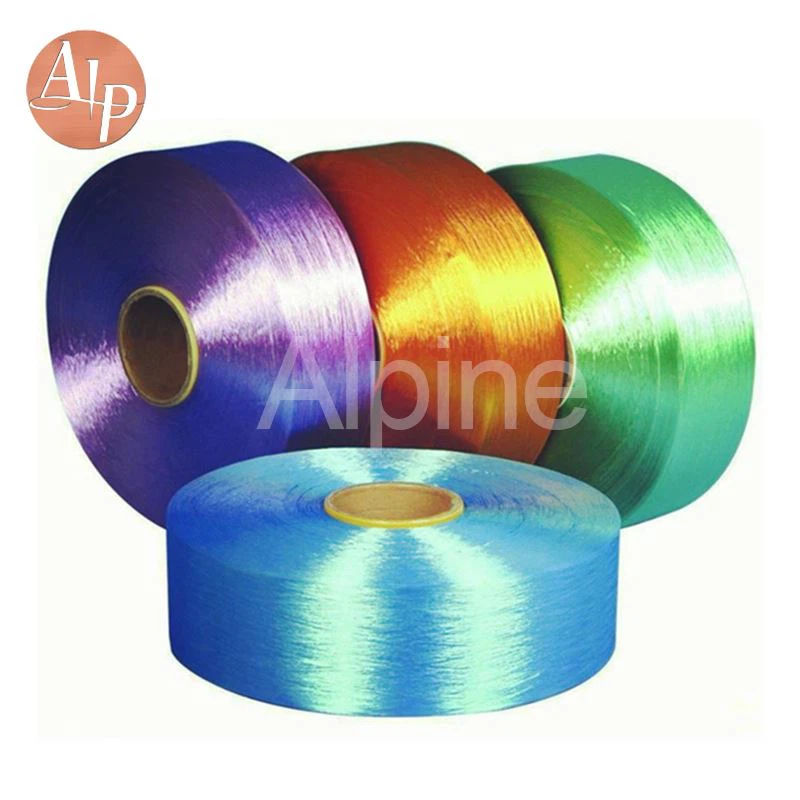
100% Polyester Poy Fdy, Filament Yarn, DDB Or Other Dope Dyed Colors. POY is used for making Polyester Drawn Textured Yarn (DTY). Both have gained the recognition of Oeko Tex Standard 100 (Class I). They are widely used in woven label , overlooking , ribbon, rope, shoelace, elastic tape etc.

We are a professional supplier specialized in producing Polyester Drawn Textured Yarn with more than 15 years' experience. We sell our products to Indonesia, Pakistan, Spain, Belgium, USA, Mexico, Algeria, Turkey, South Africa, Brazil, Uzbekistan etc. Reasonable price, good quality, nice packing, prompt shipment are our advantages and also the necessary conditions to be your stable supplier.

DTY polyester yarn is a type of polyester filament yarn produced by processing POY through a texturing process. It can be used for weaving and knitting of fabrics. We can supply all kinds of DTY polyester yarn, we can customize according to customers' request. We weekly or monthly export to Spain, Mexico, Pakistan, South America, Turkey etc and enjoy a good reputation.

Polyester Draw Textured Yarn is a type of polyester filament yarn produced by processing POY through a texturing process. It can be used for weaving and knitting of fabrics.
Why Choose Us
High quality
We use the most advanced machinery and equipment and the best raw materials for production.
Competitive price
Based on your order quantity, we can offer you a discount. The larger the order quantity, the greater the discount.
Rich experience
We have nearly 20 years of production experience, rich experience and high-quality management to ensure the quality of our products.
After-sale service
We provide comprehensive after-sales service to ensure that customers have a good practice of our products.
Semi-dull POY
This type of POY has a low luster and a natural white color. It is suitable for dyeing and texturizing to produce various colors and effects.lad to assist you in these tasks.
Bright POY
This type of POY has a high luster and a bright white color. It is often used for making shiny fabrics, such as satin or chiffon.
Dope-dyed POY
This type of POY is dyed during spinning, meaning the color is embedded in the fiber. It has better color fastness and uniformity than dyed POY. It also saves water and energy consumption during the dyeing process.
Micro-denier POY
This type of POY has a very low denier, usually less than 1. It is very fine and soft and can produce fabrics with a silky touch.
High-tenacity POY
This type of POY has high strength and durability, which makes it suitable for making fabrics that require high performance, such as sportswear or industrial textiles.
Application of Poy Yarn
Apparel
Partially oriented yarn is widely used in the production of different types of apparel. It is preferred for sportswear, activewear, lingerie, dresses, shirts, and more.
Home textiles
Partially oriented yarn is used in making various home textile products like curtains, upholstery fabrics, bed sheets, pillowcases, and blankets. Its softness, dimensional stability, and vibrant color retention properties make it ideal for improving the aesthetics and comfort of home interiors.
Technical textiles
Partially oriented yarn is used in technical textiles, which serve specific functional purposes. It finds application in geotextiles, medical textiles, automotive textiles, industrial fabrics, and filtration materials.
Filament yarn
Partially oriented yarn serves as a precursor for producing other types of filament yarns. It can be further processed into fully drawn yarn (fdy), texturized yarn, or air-jet textured yarn, which are used in various textile applications.
Narrow fabrics
Partially oriented yarn is used in the production of narrow fabrics, which are narrow-width textile products like ribbons, tapes, and straps. These narrow fabrics find applications in trimmings, labels, belts, webbings, and various decorative purposes.
How to Maintain Poy Yarn
Washing Washing is an important step to keep Poy yarn clean. When washing Poy yarn, first carefully check the washing instructions on the washing label and choose the appropriate water temperature and detergent according to the washing instructions. Generally speaking, Poy yarn is suitable for washing in warm water. Avoid using overheated water to prevent fiber deformation. At the same time, choose a neutral detergent and avoid using detergents containing bleach or strong alkaline ingredients to avoid damaging the fiber. In addition, be gentle during the washing process and avoid excessive rubbing to prevent the textile from pilling or deformation. Ironing Ironing is an important step to restore the smooth appearance of Poy yarn. When ironing Poy yarn, first check the ironing instructions and choose the appropriate temperature level according to the ironing temperature to avoid melting and deformation of the fiber due to overheating. Before ironing, you can spray water on the fiber surface appropriately, and then iron it quickly and gently with an iron to avoid local overheating caused by staying too long. In addition, for Poy yarn with special textures or prints, a thin cloth can be placed on the inside before ironing to avoid surface damage. Storage Storage is an important step to protect polyester products. When storing Poy yarn, first make sure the textile is completely dry to avoid a humid environment that causes mold growth. Secondly, the fiber product should be laid flat to avoid folding that causes obvious wrinkles and affects the overall appearance. In addition, the fiber product can be placed in a well-ventilated wardrobe or storage box to avoid direct sunlight or dust accumulation to maintain the color and texture of the fiber. Through the correct washing, ironing and storage methods, we can effectively protect the health and beauty of Poy yarn. I hope that the maintenance guide in this article can help you better maintain the quality of fiber products, extend their service life, and bring more convenience and comfort to your life.
Process of Poy Yarn
Raw material selection
The journey of creating poy yarn begins with the selection of high-quality raw materials. Typically, these are polymer chips, predominantly made of polyethylene terephthalate (pet).
Melting and extrusion
These polymer chips are melted at high temperatures. The molten polymer is then extruded through a spinneret, which determines the filament's thickness.
Cooling and solidification
Upon exiting the spinneret, the molten filaments are cooled and solidified, forming continuous strands of yarn.
Drawing and partial orientation
The solidified yarn is then stretched, or drawn, to a certain extent. This step is crucial as it partially orients the polymer molecules, giving your yarn its unique characteristics.
Winding and packaging
Finally, the yarn is wound onto large bobbins or spools, ready for shipping to textile manufacturers who will further process it into textured yarns or other products.
Quality control
Throughout this process, stringent quality control measures are in place to ensure the consistency and quality of the poy yarn produced.
Technological advances
Advancements in technology continuously refine this manufacturing process, enhancing efficiency and the quality of the final product.
Environmental considerations
Sustainable practices are increasingly being integrated into the manufacturing process to minimize environmental impact.
Market demand and adaptation
The production of your yarn is highly adaptable, allowing manufacturers to respond swiftly to changing market demands and trends.
What Is the Difference Between Poy and Fdy?
Poy (pre-oriented yarn) and fdy (fully drawn yarn) are both types of synthetic fibers, particularly within the polyester filament yarn category. They differ in several key aspects, including their production process, properties, and end uses.
Poy (pre-oriented yarn): Poy is a partially oriented yarn produced through high-speed spinning. It is an intermediate product between unoriented yarn (udy) and fully drawn yarn (fdy). Poy has a certain degree of orientation but is not fully stretched, making it suitable for further processing into other yarn types.
Fdy (fully drawn yarn): Fdy is a fully drawn yarn produced by further stretching the poy or other intermediate yarn in a continuous process. This results in a yarn with high orientation and moderate crystallinity.
Orientation and stability: Poy has a moderate degree of orientation, while fdy is fully oriented. As a result, fdy is more stable and has less residual elongation (typically below 40%) compared to poy, which can have residual elongation above 50%.
Strength and modulus: Fdy typically exhibits higher strength and modulus due to its full orientation. Poy, being partially oriented, may have slightly lower strength but retains some extensibility.
Texture: Both poy and fdy are straight fibers, but fdy's fully drawn structure gives it a tighter and more compact appearance.
Poy: Due to its partial orientation and extensibility, poy is often used as a feedstock for further processing into textured yarns such as dty (draw textured yarn). It can also be used directly in some applications where a moderate degree of orientation is sufficient.
Fdy: Fdy's high strength, stability, and smooth texture make it ideal for use in weaving and knitting applications. It is commonly used in the production of fabrics for clothing, home textiles, and industrial applications. Fdy fabrics are known for their smooth handfeel and good dimensional stability.
The main differences between poy and fdy lie in their production processes, properties, and end uses. Poy is a partially oriented yarn suitable for further processing, while fdy is a fully drawn yarn with high strength, stability, and suitability for direct use in textile applications.
How to Choose a Poy Yarn

Assessing material properties
Understanding the intrinsic properties of poy yarn, such as tensile strength, elasticity, and dyeability, is essential for matching it with the intended use.
Application requirements
Consider the specific requirements of the application, such as durability, flexibility, and aesthetic preferences.
Compatibility with other materials
Ensure compatibility of poy yarn with other materials it will be combined with, especially in composite fabrics.
Environmental considerations
Choose environmentally friendly your yarn variants, especially for applications where sustainability is a priority.
Supplier reputation and quality standards
Select poy yarn from reputable suppliers who adhere to high-quality standards and consistent production practices.

Testing and sampling
Conducting tests and obtaining samples can help in evaluating the suitability of your yarn for specific applications.
Cost vs. Performance
Balance the cost of poy yarn with the performance benefits it offers to ensure economic viability.
Industry standards and regulations
Ensure that the chosen poy yarn meets industry-specific standards and regulations, particularly for technical and medical applications.
Technological advancements
Stay informed about the latest technological advancements in your yarn to choose the most innovative and efficient options.
Future needs and scalability
Consider future needs and scalability, especially for applications in rapidly evolving industries or markets.
Personal protective equipment (ppe)
The operator should wear appropriate ppe such as gloves and safety glasses to protect themselves from the hot yarn and any potential hazards.
Proper ventilation
Adequate ventilation should be provided to prevent any fumes or gases from accumulating in the work area.
Temperature control
The temperature of the hot melt yarn should be closely monitored to ensure that it does not exceed the recommended temperature and create any burn or fire hazards.
Machine safety
All machines involved in the process should be properly maintained and guarded to prevent any accidents.
Regulatory requirements
Manufacturers should comply with relevant regulations and standards, such as those set by the occupational safety and health administration (osha) in the united states.
Company Introduction
Hangzhou Qiandao Lake Alpine Foreign Trade Ltd was established in. It is a leading supplier of yarn and fabric more than 10 years. It mainly engaged in producing virgin and recycled POY, DTY, ACY, FDY, Embroidery thread.

Our Certificate


FAQ
Hot Tags: poy yarn, China poy yarn manufacturers, suppliers, factory, Polyester Embroidery Thread, Spun Polyester Thread, Soft Polyester Yarn, Fdy, Polyester Microfiber Yarn, Poly Viscose Yarn


