


As a supplier of Polyester Weaving Yarn, I've encountered numerous inquiries regarding the shrinkage rate of this product during heat setting. Heat setting is a crucial process in the textile industry, especially for polyester materials, as it can significantly influence the final properties and quality of the woven fabric. In this blog, I'll delve into the factors that affect the shrinkage rate of polyester weaving yarn during heat setting, how to measure it, and its implications for our customers.
Understanding Polyester Weaving Yarn and Heat Setting
Polyester weaving yarn is widely used in the textile industry due to its excellent properties such as high strength, good elasticity, and resistance to wrinkles. Heat setting is a thermal treatment process that stabilizes the dimensions of the yarn and fabric, reduces shrinkage during subsequent processing or use, and improves the fabric's appearance and performance.
When polyester weaving yarn is heated during the heat - setting process, the polymer chains within the yarn start to move and re - arrange themselves. This movement can lead to a change in the yarn's length and width, resulting in shrinkage. The shrinkage rate is defined as the percentage change in the yarn's dimensions before and after heat setting.
Factors Affecting the Shrinkage Rate
1. Temperature
Temperature is one of the most critical factors affecting the shrinkage rate of polyester weaving yarn. As the temperature increases, the kinetic energy of the polymer chains in the yarn also increases. This allows the chains to move more freely and re - orient themselves into a more stable conformation. Generally, higher heat - setting temperatures lead to higher shrinkage rates. For example, if the heat - setting temperature is set at 150°C, the shrinkage rate might be around 5 - 8%. However, when the temperature is raised to 180°C, the shrinkage rate could increase to 10 - 15%.
2. Time
The duration of the heat - setting process also plays a significant role. Longer heat - setting times provide more opportunity for the polymer chains to re - arrange. If the heat - setting time is too short, the polymer chains may not have enough time to fully re - orient, resulting in a lower shrinkage rate. On the other hand, excessive heat - setting time can cause over - shrinkage and may even damage the yarn's structure. A typical heat - setting time for polyester weaving yarn ranges from 30 seconds to 2 minutes, depending on the specific requirements of the product.
3. Yarn Structure
The structure of the polyester weaving yarn, such as its twist level and density, can affect the shrinkage rate. Yarns with a higher twist level tend to have a lower shrinkage rate because the twisted structure restricts the movement of the polymer chains. Similarly, denser yarns may also have a lower shrinkage rate compared to looser ones.
4. Additives and Finishes
Some additives and finishes applied to the polyester weaving yarn can influence the shrinkage rate. For example, anti - shrinkage agents can be used to reduce the shrinkage of the yarn during heat setting. These agents work by cross - linking the polymer chains or forming a protective layer on the yarn surface, which restricts the movement of the chains.
Measuring the Shrinkage Rate
To accurately measure the shrinkage rate of polyester weaving yarn during heat setting, the following steps can be followed:
- Sample Preparation: Cut a sample of the polyester weaving yarn with a known length (usually around 100 cm). Make sure the sample is straight and free from any knots or tangles.
- Initial Measurement: Measure the length of the sample accurately using a ruler or a measuring device. Record this length as (L_0).
- Heat Setting: Place the sample in a heat - setting machine at the desired temperature and for the specified time. Follow the standard heat - setting procedures for polyester yarn.
- Cooling: After heat setting, remove the sample from the machine and allow it to cool to room temperature. This is important because the yarn may continue to shrink slightly as it cools.
- Final Measurement: Measure the length of the cooled sample again and record it as (L_1).
- Calculation: Calculate the shrinkage rate using the following formula:
[Shrinkage\ Rate(%)=\frac{L_0 - L_1}{L_0}\times100]
Implications for Customers
The shrinkage rate of polyester weaving yarn during heat setting has several implications for our customers.
1. Fabric Design
Knowledge of the shrinkage rate is essential for fabric designers. They need to take the shrinkage into account when designing the fabric to ensure that the final product has the desired dimensions. For example, if a fabric designer wants to produce a fabric with a specific width and length, they need to start with a larger piece of yarn or fabric to compensate for the shrinkage during heat setting.
2. Quality Control
In the textile manufacturing process, maintaining a consistent shrinkage rate is crucial for quality control. A significant variation in the shrinkage rate can lead to uneven fabric dimensions, which can affect the fabric's appearance and performance. By carefully controlling the heat - setting parameters, we can ensure that the shrinkage rate of our polyester weaving yarn is within the acceptable range.
3. Product Performance
The shrinkage rate can also affect the product's performance. A proper shrinkage rate can improve the fabric's dimensional stability, making it less likely to shrink or stretch during subsequent washing or use. This is particularly important for products such as clothing and home textiles, where dimensional stability is a key quality factor.
Our Product Offerings
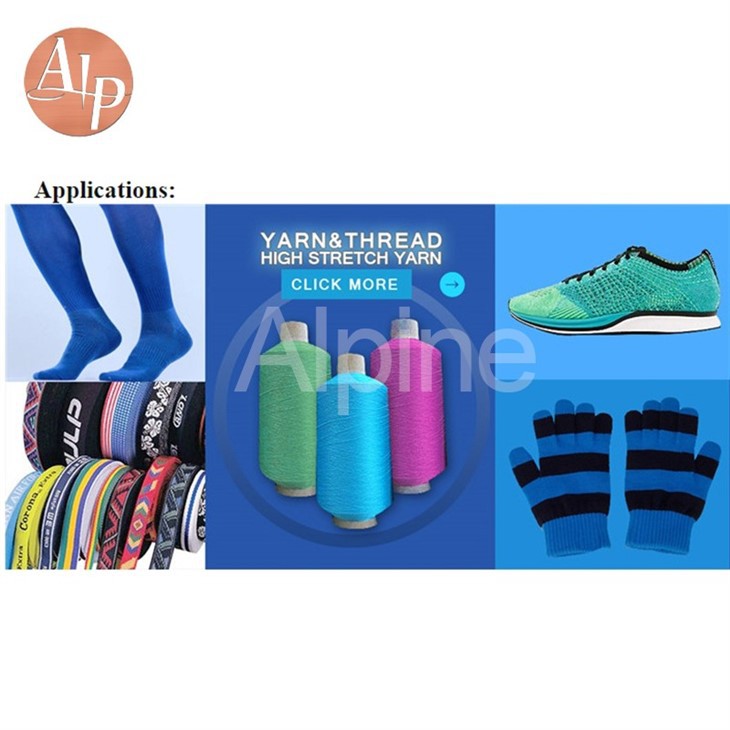
We offer a wide range of polyester weaving yarn products, including Polyester Microfiber Yarn, 100% Polyester Yarn, and Dty Yarn. Our products are known for their high quality, consistent shrinkage rates, and excellent performance. We use advanced manufacturing techniques and strict quality control measures to ensure that our yarns meet the highest industry standards.
Contact Us for Procurement
If you are interested in purchasing our polyester weaving yarn products, we welcome you to contact us for further discussion. Our team of experts can provide you with detailed information about our products, including the shrinkage rate under different heat - setting conditions. We are committed to providing you with the best products and services to meet your specific needs. Whether you are a small - scale textile manufacturer or a large - scale brand, we can work with you to develop the most suitable solutions.

References
- Textile Chemistry and Physics, Second Edition. Arthur H. Worthen.
- Handbook of Textile Fibre Structure, Volume 2: Man - Made Fibres. Edited by R. H. Blackburn.
- Polyester Fibers: Science and Technology. Edited by S. Fakirov.