


Hey there! As a supplier of Fdy Yarn, I often get asked about the tensile strength test method for this type of yarn. So, I thought I'd share some insights on this topic in today's blog post.
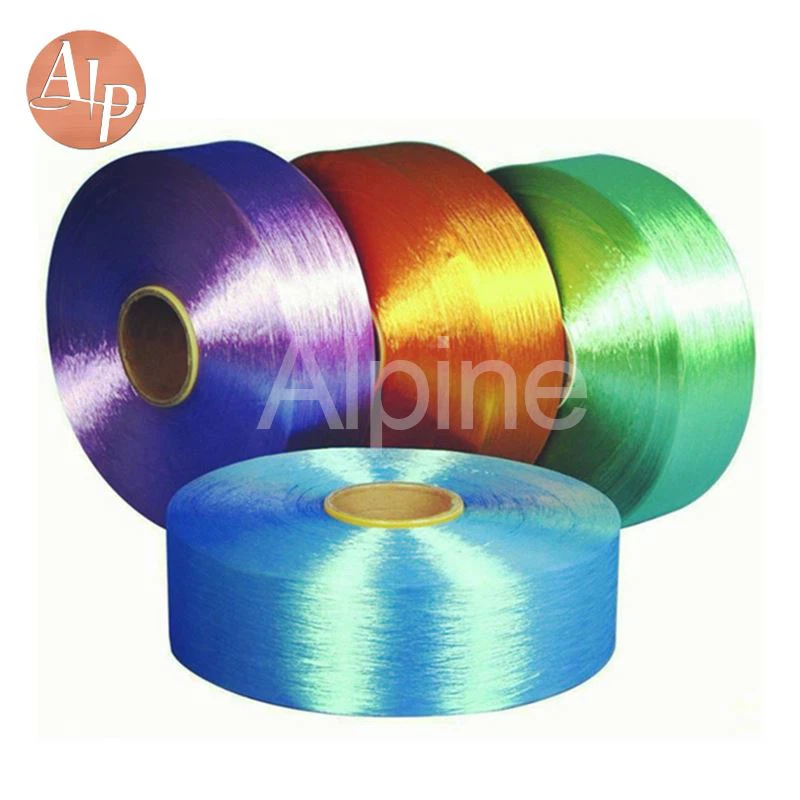
First off, let's understand what Fdy Yarn is. Fdy stands for Fully Drawn Yarn. It's a type of polyester yarn that's widely used in various textile applications. You can check out more about different types of Fdy Yarn on our website, like Polyester Fabric Yarn and Polyester Chenille Yarn. If you want to know more about our Fdy Yarn in general, head over to Fdy Yarn.
Now, the tensile strength of Fdy Yarn is a crucial property. It refers to the maximum amount of tensile stress that the yarn can withstand before it breaks. Knowing the tensile strength helps in determining the quality and suitability of the yarn for different applications.
There are a few common methods to test the tensile strength of Fdy Yarn. One of the most widely used methods is the single - yarn tensile test.
Single - Yarn Tensile Test
In this test, a single strand of Fdy Yarn is taken. First, we need to prepare the sample properly. The length of the test specimen is usually standardized. For most cases, a length of 500 mm is used, but it can vary depending on the specific testing requirements.
We use a tensile testing machine for this purpose. The machine has two clamps. One end of the yarn is firmly clamped at the top of the machine, and the other end is clamped at the bottom. The machine then starts to apply a gradually increasing tensile force on the yarn at a constant rate.
The rate of extension is also an important factor. Usually, it's set at a specific speed, like 500 mm/min. This ensures that the test is consistent and comparable across different samples.
As the machine pulls the yarn, it records the force applied and the corresponding extension of the yarn. The test continues until the yarn breaks. The maximum force recorded at the moment of breakage is the breaking force of the yarn.
To calculate the tensile strength, we use the following formula:
Tensile strength (cN/tex) = Breaking force (cN) / Linear density (tex)
The linear density of the yarn, which is measured in tex, represents the mass in grams of 1000 meters of the yarn. Once we have the breaking force and the linear density, we can easily calculate the tensile strength.
Factors Affecting the Tensile Strength Test
There are several factors that can affect the results of the tensile strength test.
Moisture content: Yarns can absorb moisture from the environment. Higher moisture content can make the yarn more flexible and can reduce its tensile strength. So, it's important to condition the yarn samples in a standard atmosphere before testing. Usually, the samples are kept in an environment with a relative humidity of 65% and a temperature of 20°C for a certain period, say 24 hours, to ensure consistent moisture levels.
Twist level: The twist in the yarn plays a significant role. A higher twist can increase the friction between the fibers in the yarn, which can enhance the tensile strength to some extent. However, if the twist is too high, it can also cause damage to the fibers and reduce the strength. So, the twist level needs to be controlled and measured accurately.
Fiber properties: The quality and characteristics of the polyester fibers used in the Fdy Yarn also affect the tensile strength. Fibers with better orientation and higher molecular weight generally result in yarns with higher tensile strength.
Another Method: Bundle Tensile Test
Apart from the single - yarn tensile test, the bundle tensile test is also used in some cases.
In the bundle tensile test, a bundle of several yarns is taken instead of a single strand. The number of yarns in the bundle can vary, but it's usually around 10 - 20.
The principle is similar to the single - yarn test. The bundle is clamped in the tensile testing machine, and a tensile force is applied at a constant rate until the bundle breaks.
However, the calculation of the tensile strength in the bundle test is a bit more complex. We need to consider the number of yarns in the bundle and their individual linear densities.

Importance of Tensile Strength Testing for Fdy Yarn Suppliers
As an Fdy Yarn supplier, tensile strength testing is extremely important for us. It helps us in quality control. By regularly testing the tensile strength of our yarns, we can ensure that we are providing high - quality products to our customers.
It also helps in product development. We can use the test results to improve our manufacturing processes. For example, if we find that the tensile strength of our yarns is lower than expected, we can adjust the spinning parameters, like the spinning speed or the cooling conditions, to enhance the strength.
Moreover, when dealing with customers, the tensile strength data is a valuable selling point. Customers can use this information to choose the right yarn for their specific applications. For instance, if a customer is making a high - stress fabric, they will need a yarn with a high tensile strength.
Conclusion
In conclusion, the tensile strength test of Fdy Yarn is a vital process that helps in ensuring the quality and suitability of the yarn for various applications. Whether it's the single - yarn tensile test or the bundle tensile test, each method has its own advantages and is used depending on the specific requirements.
As an Fdy Yarn supplier, we are committed to providing high - quality yarns. By conducting regular and accurate tensile strength tests, we can offer our customers yarns that meet their needs.
If you're interested in purchasing Fdy Yarn or have any questions about the tensile strength or other properties of our yarns, don't hesitate to get in touch with us. We're here to help you find the perfect yarn for your projects.
References
- Textile Testing Handbook, Third Edition, by B. A. Collier and S. Shishoo
- ASTM D2256/D2256M - 19 Standard Test Method for Tensile Properties of Yarn by the Single - Strand Method